Let's be honest: the gym feels like a distant memory when you've got kids. Between early mornings, work deadlines, and bedtime routines, finding 60 minutes to work out seems laughable. But here's the truth — you don't need a gym, fancy equipment, or even a full hour to stay fit as a dad.
What you need is a simple, repeatable routine that fits into the cracks of your day. And the good news? Science backs up that short, consistent workouts are just as effective for long-term health as marathon gym sessions.
This guide gives you a realistic, no-equipment exercise routine designed specifically for busy dads — one you can do in your living room, garden, or even your office during a lunch break.
Why Dads Struggle to Exercise (And Why It Matters)
According to the CDC, only 23% of adults meet the recommended guidelines for both aerobic and strength-training activity. For fathers with young children, that number drops even further.
The barriers are real:
- Time scarcity — Between work and family, free time evaporates
- Decision fatigue — After a long day, choosing a workout feels like one more task
- All-or-nothing thinking — "If I can't do a full hour, why bother?"
- Guilt — Taking time for yourself can feel selfish when your partner is also exhausted
But exercise isn't a luxury — it's a performance enhancer for fatherhood. Regular movement improves sleep quality, reduces stress hormones, boosts energy, and makes you more patient with your kids. As we explored in staying active as a dad with zero free time, even small amounts of movement compound into significant health benefits.
The 15-Minute Dad Workout (Zero Equipment)
This routine is designed to hit every major muscle group in under 15 minutes. No equipment, no excuses. Do it three to four times per week for noticeable results within a month.
Warm-Up (2 Minutes)
- 30 seconds of marching in place
- 30 seconds of arm circles (forward and backward)
- 30 seconds of bodyweight squats (slow tempo)
- 30 seconds of torso twists
Circuit (Do 3 Rounds, 30 Seconds Each Exercise)
1. Push-Ups (or Knee Push-Ups)
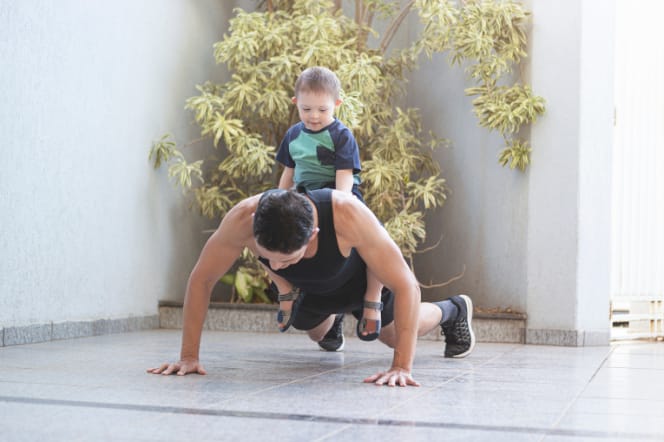
The king of upper-body exercises. Keep your core tight and lower your chest to the floor. If full push-ups are too challenging, drop to your knees — there's zero shame in modification.
2. Bodyweight Squats
Stand with feet shoulder-width apart, push your hips back, and lower until your thighs are parallel to the floor. Drive through your heels to stand. Bonus: hold your toddler for added resistance.
3. Plank Hold
Forearms on the floor, body in a straight line from head to heels. Squeeze your glutes and brace your core. If 30 seconds feels easy, aim for 45.
4. Reverse Lunges
Step one foot back, lower your back knee toward the floor, then drive back up. Alternate legs. This builds single-leg strength and balance — essential for chasing toddlers.
5. Superman Hold
Lie face down, arms extended overhead. Lift your arms, chest, and legs off the floor simultaneously. Hold for 2–3 seconds, lower, repeat. This strengthens your lower back and counters all that slouching at your desk.
Rest 30 seconds between rounds.
Cool-Down (2 Minutes)
- 30 seconds child's pose
- 30 seconds standing quad stretch (each leg)
- 30 seconds standing hamstring stretch
When to Work Out as a Busy Dad
The best time to exercise is whenever you can actually do it. But here are windows that work well for most dads:
Before the kids wake up. Even 15 minutes before the household stirs can set your energy for the day. As we covered in the morning routine that works for dads, anchoring exercise to your wake-up time builds an automatic habit.
During nap time. If you work from home or are a stay-at-home dad, nap time is golden. Resist the urge to scroll — use 15 minutes for movement instead.
Lunch break. No commute to the gym needed. Close your laptop, do the circuit in your living room, and shower. You'll return to work sharper.
After bedtime. Once the kids are down, you have a window. The risk here is fatigue — if evening workouts leave you wired, stick to morning or midday.
How to Make It Stick: The Habit Loop for Dads
Research from the University College London shows it takes an average of 66 days to form a new habit. Here's how to make exercise automatic:
- Anchor it to an existing habit. "After I brush my teeth in the morning, I do 15 minutes of exercise." Linking new behaviours to established routines dramatically increases follow-through.
- Set the bar absurdly low. On days you feel zero motivation, commit to just 5 minutes. You'll almost always do more once you start — but even if you don't, 5 minutes counts.
- Track it visibly. A simple calendar with X marks for completed workouts creates a "don't break the chain" effect that builds momentum.
- Tell your partner. Accountability matters. Let them know your schedule so they can support you — and offer the same in return.
- Forgive missed days. You will miss workouts. Kids get sick, work explodes, life happens. The goal isn't perfection — it's consistency over months, not days.