Quick answer
Most babies take their first independent steps between 9 and 18 months, with the average sitting around 12 months. Anything inside that window is normal — early walkers aren't smarter, late walkers aren't behind. Talk to your GP or pediatrician if your baby isn't pulling to stand by 12 months or isn't walking by 18 months.
Reviewed by Richard, dad of two — last updated June 2026.
You're watching your kid cruise along the sofa for the hundredth time today, one hand white-knuckled on the cushion, and you're wondering: when does this actually turn into walking? Maybe your group chat is full of toddlers already toddling and yours is still bum-shuffling like it's a career. Or maybe yours is suddenly launching themselves off the coffee table at 10 months and you're not sure whether to celebrate or buy more bubble wrap.
Here's the honest version, from someone who has been through it twice and read more developmental literature than is healthy.
When do babies start walking?
Most babies take their first unsupported steps somewhere between 9 and 18 months. The NHS Start for Life guidance puts the typical range at around 12 to 18 months, and the American Academy of Pediatrics says the same thing: by 18 months, the vast majority of healthy babies are walking independently.
The average — the boring middle of the bell curve — is roughly 12 months. But "average" is a statistic, not a target. If your baby is 14 months and still crawling like a Formula 1 car, that's normal. If they walked at 10 months, that's also normal. The window is genuinely wide.
What matters more than the date is the sequence. Walking is the last brick in a tower of smaller skills, and babies build the tower in roughly the same order even when their timeline differs.
The 6 stages before walking (so you know what to look for)
Forget the calendar for a minute. These are the milestones that actually predict walking, usually in this order:
- Sitting unsupported (around 6–8 months). Core strength is the foundation. No core, no standing.
- Crawling or bum-shuffling (around 7–10 months). Some babies skip crawling entirely — we cover the full picture in When Do Babies Start Crawling?. Skipping it doesn't delay walking.
- Pulling to stand (around 8–11 months). Usually on you, the sofa, or the dishwasher door at the worst possible moment.
- Cruising (around 9–13 months). Side-stepping along furniture with both hands, then one hand, then briefly no hands.
- Standing unsupported for a few seconds (around 10–14 months). The "wait, are they… oh they sat down" phase.
- First independent steps (around 9–18 months). Usually 2–3 wobbly steps before a controlled crash into your arms.
If your baby is moving through this sequence — even slowly — you're almost certainly fine. Pediatricians look at the pattern, not the specific month.
For the language side of development, see our guide to first words and early language.
Why do some babies walk early and others walk late?
Walking timing comes down to a mix of:
- Genetics. If you or your partner walked late, your baby probably will too. This is the single biggest factor and the most ignored one.
- Body type. Leaner, lighter babies often walk earlier than chunkier ones — less weight to lift, less to balance.
- Temperament. Cautious babies wait until they're sure. Bold ones launch and learn. Neither predicts anything about intelligence or future personality.
- Opportunity. Babies who spend most of their day in containers — bouncers, jumperoos, walkers, car seats — get less floor time. Floor time is where walking is built.
- Older siblings. Babies with older siblings often walk a bit earlier. They're literally chasing someone.
What does not affect when a baby walks: how often you "practise" with them, baby walkers (which actually slow it down — more on that below), expensive shoes, or whether you read to them in utero.
Is it bad if my baby walks early?
No. Early walking — say, 9 or 10 months — isn't a sign of advanced development, but it isn't dangerous either. The old wives' tale that early walking causes bow legs or hip problems isn't supported by evidence. Babies' legs naturally look bowed until around age 2, regardless of when they walk.
The only practical issue with an early walker: your house isn't ready. If your 10-month-old is suddenly mobile and upright, baby-proof again with adult eyes. Standing babies reach things crawling babies couldn't — hot drinks on coffee tables, dangling cables, the dog's water bowl, the cat. Re-sweep at standing height.
Is it bad if my baby walks late?
Usually no. A baby who walks at 16 or 17 months is statistically completely normal and almost always catches up to peers within a few months. There's no evidence that late walkers are slower at anything later in life — sport, school, anything. Plenty of late walkers are early talkers and vice versa; babies tend to focus their energy on one big skill at a time.
That said, there's a small group of red flags worth flagging to your GP or pediatrician. If your baby:
- Isn't pulling to stand by 12 months
- Isn't cruising along furniture by 14 months
- Isn't walking independently by 18 months
- Is walking but persistently on tiptoes, dragging one leg, or has noticeably asymmetric movement
- Has lost a skill they previously had (regression)
…book a routine review. It's almost never anything serious. Often it's a minor muscle-tone difference that resolves with a few physio sessions, or simply more time. But it's the kind of thing professionals would rather check at 14 months than at 3 years.
How can I help my baby learn to walk?
The honest answer: you mostly can't speed it up, but you can not slow it down. The best things you can do:
- Lots of barefoot floor time. Bare feet grip better than socks. Babies use their toes to balance — they need to feel the ground.
- Stable furniture they can pull up on. A heavy sofa, a sturdy ottoman, a low coffee table with rounded corners. Push wobbly things out of the cruising path.
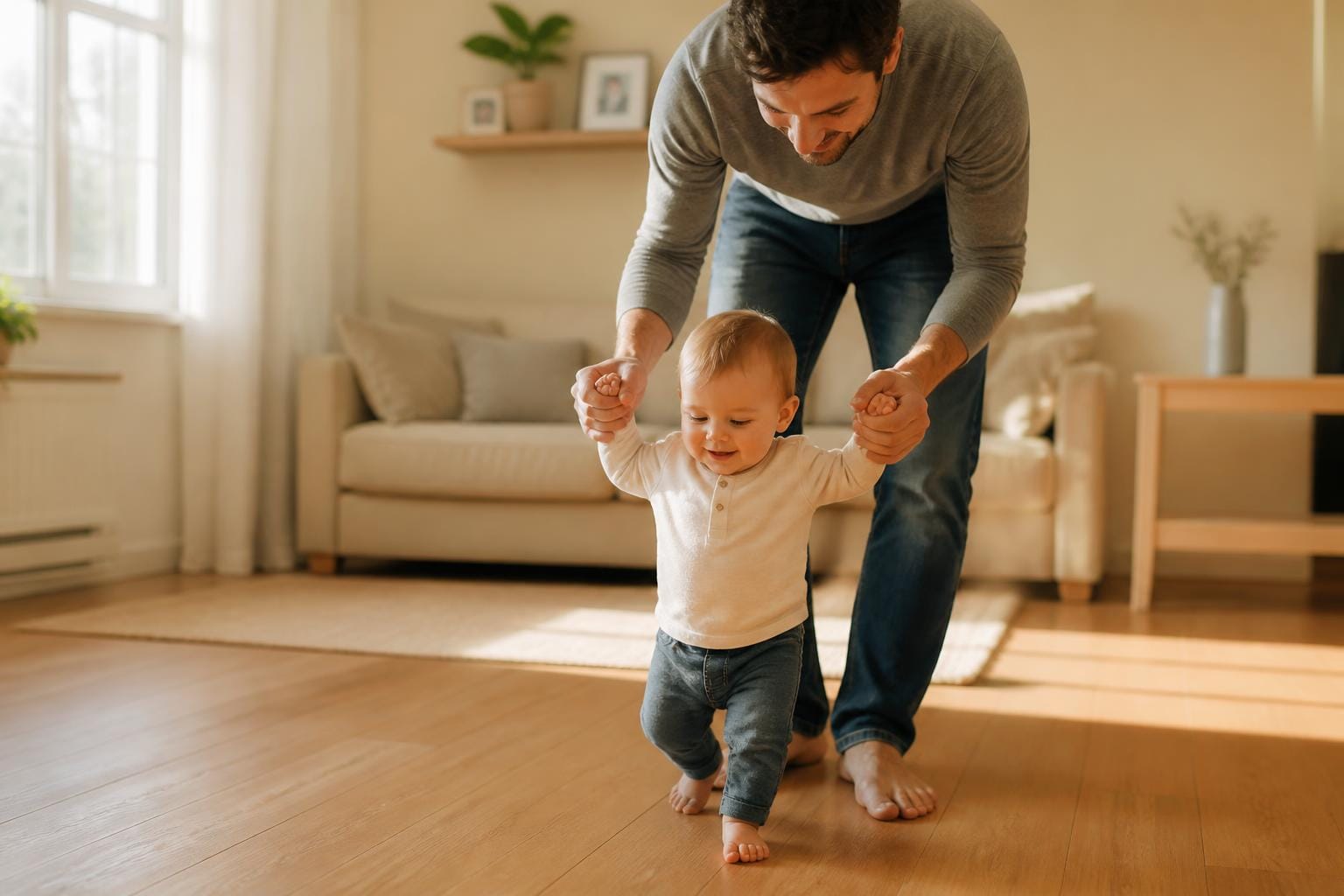
- Hold two hands, then one hand, then let go. Walking your baby around the room holding both hands lets them feel the rhythm of weight transfer without needing to balance yet. Drop to one hand when they're ready. Step back when they cruise unsupported.
- Push toys. A weighted push-along trolley (the wooden ones with bricks inside that don't run away) is genuinely useful — it gives the baby something to hold while their legs do the work.
- Resist the urge to over-help. Let them fall on their bum from a stand. The padded nappy is built for it. Falling and getting up is half the skill.