Reviewed by Richard, dad of two — last updated July 2026.
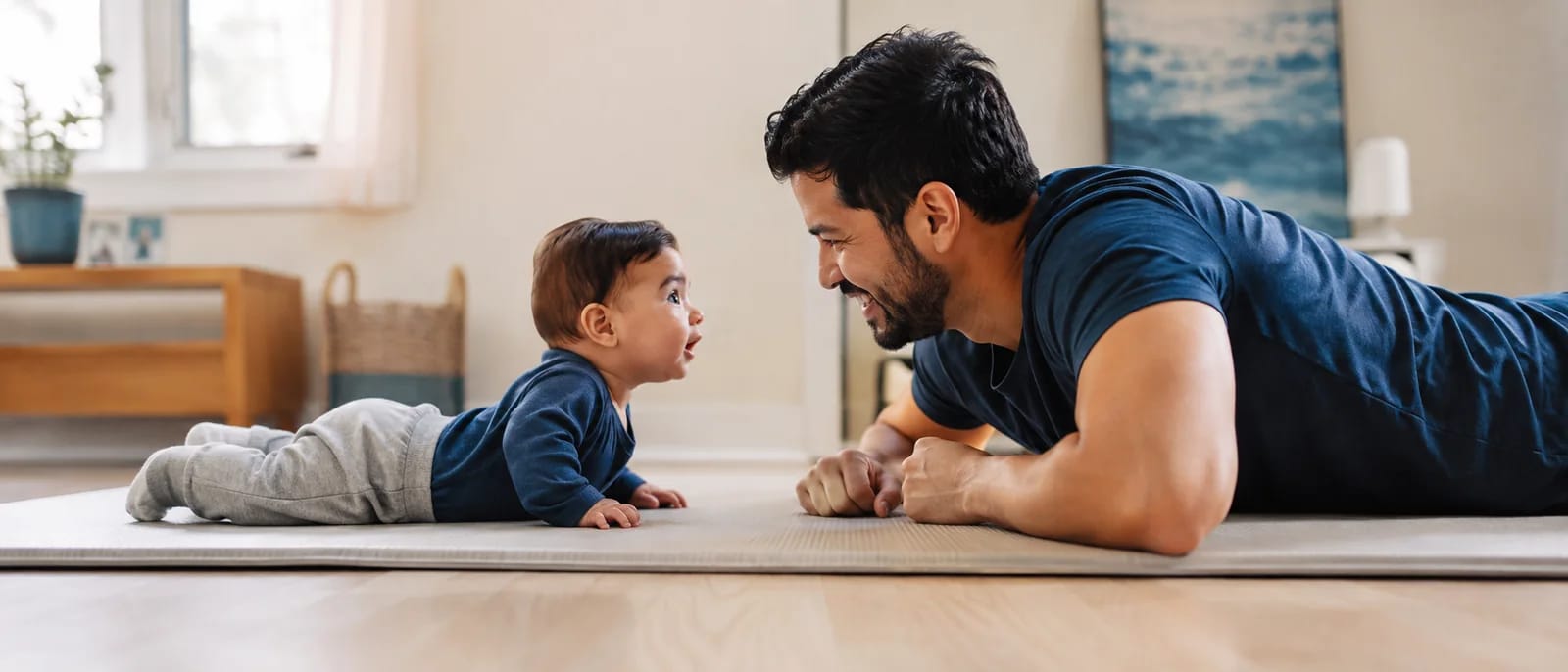
You are lying on the carpet at 6.47am. Your baby is chewing a wooden giraffe and shouting "babababa" at the ceiling like they are trying to summon it. And somewhere in the back of your head is that quiet dad question: is that a word? Is that the word? When do babies actually start talking?
You are not alone in Googling this at odd hours. First words are one of the most watched, most compared, and most quietly-stressed-about milestones in the first two years. Here is the honest answer, the range, the red flags, and the small things you can do today that actually move the needle.
Quick answer
Most babies start talking — meaning their first real word used with meaning — between 10 and 14 months, though anywhere from 9 to 18 months is normal. Babbling ("bababa", "dadada") starts around 6–9 months. By 18 months most toddlers have 6–20 words; by 24 months, 50+ words and two-word combos. If your child has no words by 18 months, or has lost words they used to say, talk to your GP or paediatrician.
When do babies say their first word?
The short version: the average first real word lands around 12 months, but the normal range is roughly 9 to 18 months. "Real" means used with meaning — pointing at the dog and saying "dog" (or "goggie"), waving at you and saying "dada", asking for milk with a consistent "muh". Random "dada" shouted at a lampshade doesn't count yet, even if your partner will absolutely count it.
The NHS gives a fair-use range: most babies say their first recognisable word between 10 and 15 months (NHS Start for Life). The American Academy of Pediatrics uses a similar window and flags 15–18 months as the point to check in with a professional if there are no words at all (HealthyChildren.org).
What tends to come first: mama, dada, bye, hi, no, up, more, an animal noise ("moo"), or the name of a pet or sibling. Which one is first is mostly random and almost entirely down to which sound is easiest for their mouth to make right now — not who they love most. If it is "mama" first, that is a mouth-shape thing, not a rejection.
What counts as a "word" at this age?
Speech therapists use a working definition that surprises most parents: a word is any consistent sound your baby uses to mean the same thing. It does not have to sound like the adult version.
- "Buh" every time they see a ball → that is a word.
- "Nana" for banana → word.
- "Sss" for the cat → word.
- An animal sound used consistently ("moo" for cow) → counts as a word.
- Signs (Baby Sign, Makaton) used consistently → also count in most milestone frameworks.
What does not count: babbling with no meaning attached, or a sound they said once at Grandma's on Sunday and never again. Consistency is the whole game. When you are keeping a mental tally of your baby's word count, use that definition — not the strict dictionary one.
Signs my baby is about to start talking
Before words come out, a lot of scaffolding gets built. If you see these, talking is coming — sometimes in weeks, sometimes in a few months:
- Joint attention. They look at something, then look at your face, then back at the thing. That triangle is language. It means they know you are a separate person who might know what they mean.
- Pointing (around 9–12 months). First to ask ("I want that"), then to show ("look at that"). Showing-pointing is a bigger predictor of language than asking-pointing.
- Following simple instructions. "Where's the ball?" and they look at it. "Wave bye-bye" and they wave. This is receptive language — comprehension always runs ahead of production.
- Varied babbling (7–10 months). Not just "aaaa" but a mix — "bagoo", "didadi" — with the rhythm and intonation of real sentences. That is called jargon.
- Imitating sounds. You cough, they cough. You say "uh-oh", they try "uh-uh". Copying is the last step before naming.
If most of that is happening, you can stop refreshing this article. Words are coming.
Talking vs babbling vs jargon — what's the difference?
Three stages, easy to confuse:
- Babbling (4–9 months): repeated consonant-vowel sounds — "bababa", "dadada", "mamama". No meaning. Universal across every language on Earth.
- Jargon (9–15 months): long strings of babble with the melody and rhythm of a sentence. Sounds like they are telling you a story in a language you don't speak. They kind of are — they are practising the music of speech before the vocabulary.
- First words (10–18 months): real words used with meaning. Often mixed into jargon at first — "bagoo doggie bagoo" — so listen carefully.
You will spend a lot of your first year not sure which one you are hearing. That is fine. The move is to respond as if everything they say means something, because eventually it will.
When should I worry my baby isn't talking?
This is the question that keeps dads up. Here is a straight answer.
Talk to your GP, health visitor, or paediatrician if:
- No babbling by 9 months.
- Not responding to their name or familiar voices by 9–12 months.
- No pointing, waving, or gestures by 12 months.
- No single words by 18 months.
- No two-word phrases ("more milk", "daddy up") by 24 months.
- Loss of any words or social skills they previously had — at any age. This one is important.
- Not responding to sound, or you have a hunch about their hearing. Get hearing checked first, always — glue ear is common, treatable, and can silently delay speech for months.
None of these guarantee a problem. They are triggers to get a professional set of eyes on it. Early support (speech and language therapy, hearing checks) is the highest-leverage thing you can do — waiting rarely helps.
What is not a reason to worry: a second child who talks later than the first (older siblings talk for them), a bilingual baby who mixes languages or seems "behind" in each one (total vocabulary across both languages is what counts, and they catch up), or a baby who understands everything but doesn't say much yet at 15 months. Understanding always comes first.
How can I help my baby learn to talk? (Dad-specific playbook)
The research on this is unusually clear. Kids whose parents talk with them a lot — not at them — have bigger vocabularies at 3, better reading at 8, and more confidence at school. And it doesn't matter which parent does it. Dad-talk counts as much as mum-talk. Here is what actually works, ranked by leverage-per-minute.
1. Narrate your day out loud
Sounds ridiculous, works brilliantly. "Right, we're putting your sock on. Left foot. There we go. Now the other one. Where's your other sock? There it is." You just gave them 25 words attached to real objects and actions. Do it during nappy changes, cooking, walks, supermarket runs. This is the single biggest thing.
2. Read one book a day
Doesn't have to be long. A board book at bedtime, the same one for a month if they want. Point at pictures, name them, pause. Babies love repetition — it is how they build predictive models of language. Any book beats no book; any book you'll actually keep doing beats the fancy one you'll abandon in a week.
3. Pause and wait
When they make a sound or point at something, pause for 3–5 seconds. Most of us fill the gap immediately. If you wait, you give them room to try a sound back. This is called serve-and-return, and it is how language becomes a two-way thing instead of a monologue you deliver at them.
4. Expand what they say
They say "buh". You say "yes, a ball! A big red ball." They said one syllable, you gave them the adult version without correcting them. Never say "no, it's a ball, not buh". Just model the fuller version and move on.
5. Sing — badly is fine
Nursery rhymes, football chants, the theme tune to whatever you're watching. Melody + repetition + rhyme is a cheat code for language acquisition. Your terrible singing voice is your baby's favourite voice on Earth — this is not up for debate.
6. Cap the screen time (yes, really)
Passive screen time under 18 months is one of the few things consistently linked to slower vocabulary growth. Video calls with grandparents are fine — those are interactive. Background TV and solo YouTube on the tablet are the ones to watch. You don't need to be perfect; you need to not have it on constantly.
Do boys really talk later than girls?
On average, yes — by about a month, sometimes two. It is a real but small effect, and it is completely swamped by individual variation. Plenty of boys talk at 10 months; plenty of girls hit 16. Don't use "he's a boy" as a reason to delay checking in with a professional if he hits one of the red flags above. The gap is real for population averages, not for your specific kid.
My baby understands everything but won't say a word — is that OK?
Usually, yes. Receptive language (understanding) always runs 3–6 months ahead of expressive language (saying). A 15-month-old who fetches the shoe, points at the dog when you ask, and follows two-step instructions is doing fine on the language front — the wiring is there, the production is coming. If they hit 18 months with strong understanding but zero words, still worth a chat with a health visitor — sometimes it is a mechanical issue (tongue tie, oral-motor) that a quick check can flag.
Three tiny things to try tomorrow
If you take one thing from this article, take these three. They cost nothing, they take under 5 minutes each, and stacked over months they matter more than any app or flashcard set.
- Narrate the nappy change. Every single one. "Off with the old one. Wipe. New one on. Legs up. Done." That is 15 words, four times a day, every day.
- Read one board book at bedtime. Pick a short one. Same one is fine. Point and name three things per page.
- Name-and-pause. When they look at something and make a sound, name the thing — "yes, that's a bus" — and then wait. Count to five in your head. Let them fill the silence.
The first word will come. It will probably come when you are not paying attention — mid-yawn on a Tuesday, or in the car park at Tesco. You will forget what it was within a week and argue with your partner about it forever. Enjoy the babbling while you have it. In two years you will be begging for five minutes of quiet.
If you are watching other early milestones and want to know what is normal, dads tend to search these next: when do babies start crawling, when do babies start teething, and when can babies start solid foods. All follow the same rule as talking: wide normal ranges, red flags to know, and small daily habits that matter more than you'd think.