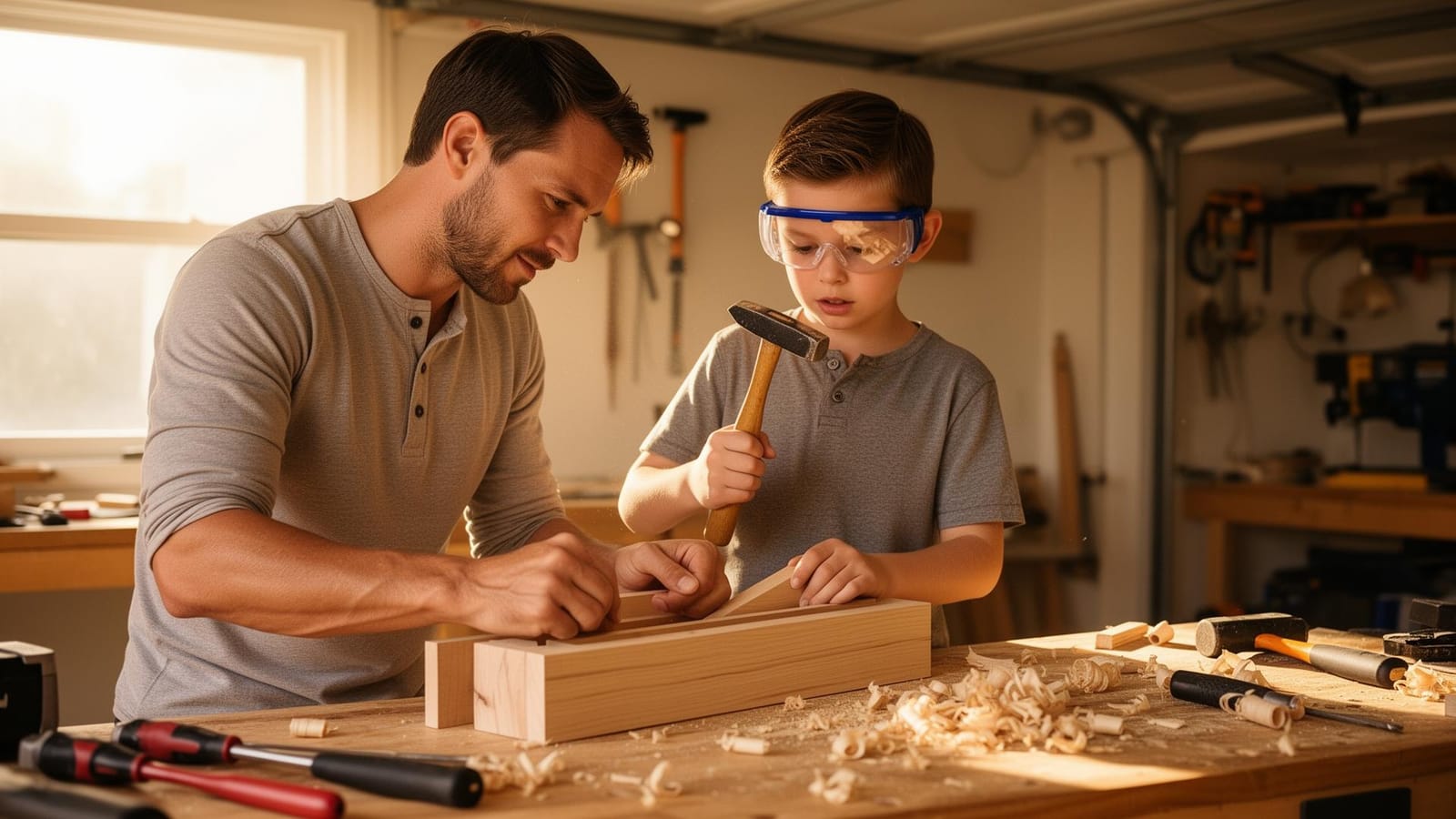
The best weekend bonding activities are not necessarily the biggest days out. Choose something simple that lets your child make decisions, gives you a shared task and leaves room for a real back-and-forth conversation. A walk, one recipe, a small build, a made-up story or a cooperative game can all work when Dad joins in instead of managing from the side.
This guide is about how to use five familiar activities for connection. If your main need is a longer list of ideas that cost nothing, use our separate guide to free weekend activities for dads and kids. For more age-specific ideas, browse the Activities and Bonding guide collection.
Quick Weekend Bonding Chooser
| Activity | Useful when | Typical time | The bonding move |
|---|---|---|---|
| Child-led walk | Everyone needs fresh air or movement | 30–60 minutes | Let your child choose part of the route or mission |
| Cook one thing | You want a practical shared task | 30–75 minutes | Give the child a real role and make decisions together |
| Build or repair | Your child enjoys making and problem-solving | 30–90 minutes | Ask before helping and treat mistakes as part of the project |
| Story creation | Energy is low or the weather is poor | 20–45 minutes | Follow the child's idea rather than correcting the plot |
| Cooperative game | Your child wants active play | 20–60 minutes | Create a shared goal instead of making Dad the judge |
What Turns an Activity Into Bonding Time?
An activity creates an opportunity; your response creates the connection. The American Academy of Pediatrics describes play as a setting for parent engagement, shared communication and safe, nurturing relationships. The report was reaffirmed in January 2025.
Use three principles during any of the activities below:
- Share control. Offer two realistic choices or let your child lead one part. The CDC's guidance on child-led play recommends following the child's lead rather than filling playtime with directions.
- Notice and respond. Comment on what your child is doing, answer their signals and build on their idea. Harvard's Center on the Developing Child calls this responsive back-and-forth serve and return.
- Remove performance pressure. The goal is not the fastest walk, best-looking cake or perfect score. Let the result be ordinary while the attention is genuine.
1. Take a Child-Led Walk With a Mission
Instead of announcing a route and pace, give your child some ownership. Let them choose left or right at a safe junction, decide which colour or shape to spot, photograph five interesting textures or invent a short scavenger hunt. You can still set the boundary—how far, how long and which areas are safe—without controlling every decision.
- Ages 2–5: search for three colours, collect fallen leaves or copy animal movements.
- Ages 6–9: let the child draw a simple map, choose photo prompts or navigate a familiar park.
- Ages 10+: choose the destination together and use the side-by-side time for a low-pressure conversation.
Try prompts that do not sound like an interview: “What did you notice before I did?”, “Which way should we explore?” or “What would make this walk funnier?” If your child starts talking about something important, slow down and listen instead of rushing to the next task.
The NHS recommends varied, age-appropriate activity and gradual progression, with appropriate safety equipment where needed. See its guidance for children under five and ages 5–18. For a more active day, use our weekend outdoor activities guide.
2. Cook One Thing Your Child Helps Choose
Pick one realistic outcome—a pizza, soup, pancakes, wraps or a tray of muffins—and agree on the roles before starting. Young children can wash produce, pour measured ingredients or arrange toppings. Older children can compare recipes, prepare a shopping list, manage a timer or take responsibility for one complete stage with supervision.
The bonding part is shared decision-making. Ask, “What should we change next time?” or “Which job do you want to own?” Avoid taking over because the result looks uneven. Dad handles heat, sharp tools and food-safety decisions, but the child's contribution should remain visible in the finished meal.
If food preferences make cooking stressful, our guide to healthy meals kids may actually eat offers a calmer starting point.
3. Build, Fix or Improve Something Together
The project can be a cardboard ramp, bird feeder, model, shelf label, LEGO design or a simple repair. Choose something that can reach a usable stopping point within the time available. A half-finished ambitious project often creates more frustration than a modest build the child can genuinely influence.
Start by asking three questions: “What are we making?”, “What might be difficult?” and “Which part do you want to try first?” When something fails, describe the problem without blaming: “That join moved—what could hold it?” Ask before stepping in. Children need suitable tools, eye protection and close supervision whenever the project involves cutting, drilling, heat, electricity or small parts.
For younger children, Dad can prepare safe pieces and let the child choose, position and decorate them. Older children can sketch, measure and revise the plan. The finished object matters less than showing that their idea changed the outcome.